Finding Stillness in the Static: A Journey into Cybernova
In an age where our digital and physical lives are increasingly intertwined, the allure of a perfectly rendered virtual world is undeniable. We often imagine these spaces as chaotic, loud, and relentless—a reflection of the most frantic parts of our own online existence. But what if a cyberpunk world could be something else? What if it could be a place of quiet contemplation, of subtle beauty, and of personal discovery? This is the gentle paradox at the heart of Cybernova, a game that trades blistering action for a more meditative pace, inviting you not to conquer its world, but to understand it.
Unlike the high-octane shooters that often define the genre, Cybernova is not about saving the world from a cataclysmic event. There is no looming apocalypse, no tyrannical A.I. demanding overthrow. Instead, the game presents you with a simple, personal premise: you are a Digital Archivist, tasked with exploring the sprawling, forgotten sectors of the Nexus, a once-great virtual metropolis now left to the gentle decay of digital entropy. Your goal is not to fight, but to find, to listen, and to restore fragments of lost data—the echoes of lives once lived in this silicon landscape.
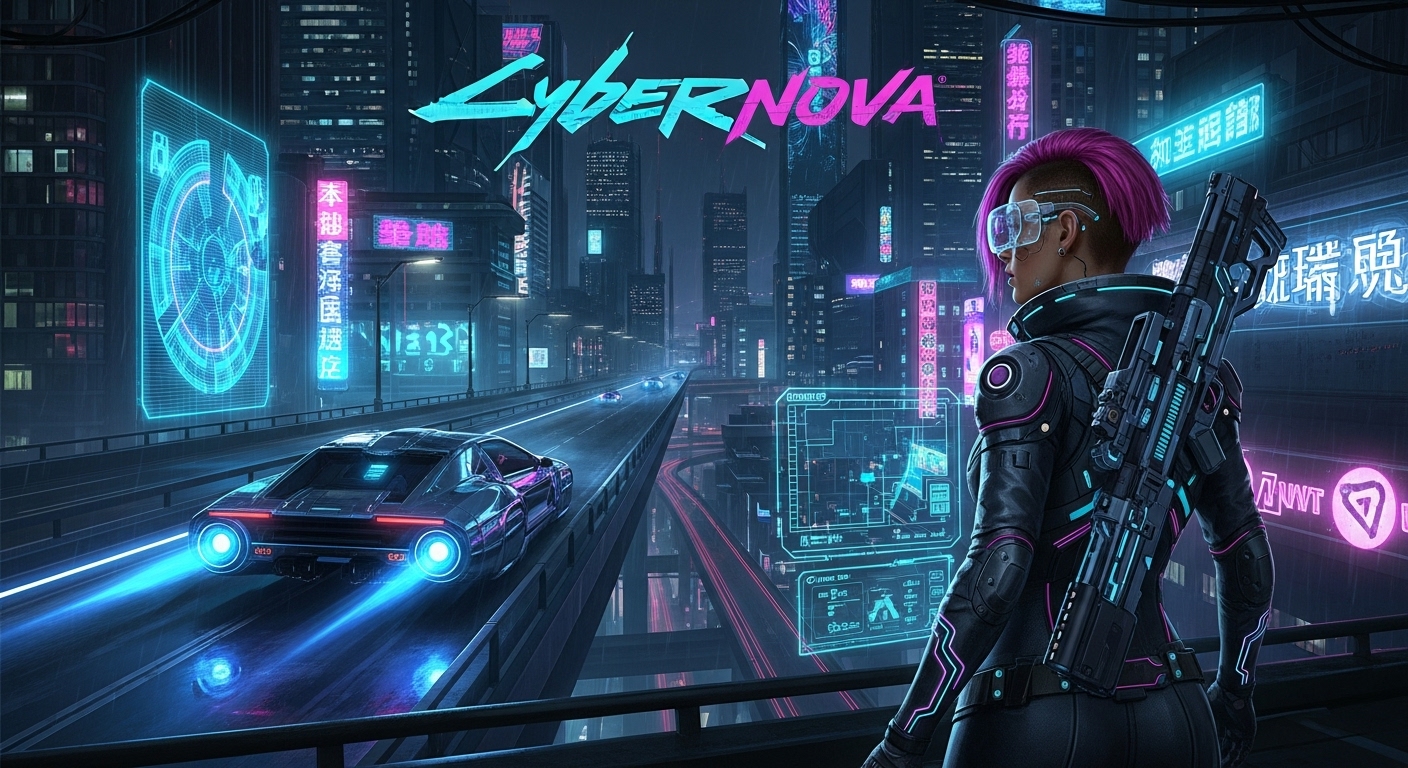
The Aesthetics of a Quiet Apocalypse
From the moment you first step into the Nexus, Cybernova establishes its unique atmosphere. This is not a world of jarring, neon-clad brutality, but one of melancholic beauty. The palette is dominated by deep indigos, electric purples, and the cool, lonely glow of cyan. Neon signs don’t scream; they hum and flicker, their light reflecting off rain-slicked, non-Euclidean geometry. The soundtrack is a masterpiece of ambient synth-wave, a blend of soft, pulsing basslines and ethereal melodies that feels less like a score and more like the city’s own steady, digital heartbeat.
The genius of Cybernova’s design is in its use of silence and space. You will spend long moments simply walking through vast, empty plazas, your footsteps echoing softly. You’ll glide through data streams that flow like serene rivers of light. The world is yours to explore at your own rhythm, with no waypoints cluttering your vision or urgent quests breaking your concentration. The game trusts you to find your own path, to be drawn to a glimmer of light in the distance or the faint, distorted whisper of a recovered memory.
The Gameplay of Observation and Connection
So, what do you actually do in Cybernova? The core gameplay loop is built on three pillars: exploration, restoration, and connection.
Your primary tool is the Archive Interface, a elegant, holographic display that allows you to scan the environment for “Data Ghosts”—residual imprints of the past. A flickering silhouette on a bench might reveal a fragment of a conversation between two lovers. A corrupted data-store, when restored, could play a snippet of a forgotten song or a citizen’s personal log. Your role is to piece these fragments together, not to complete a grand narrative, but to form a mosaic of understanding about what life was like in the Nexus.
There are puzzles, but they are environmental and intuitive. You might need to reroute power to a dormant gateway, align satellite dishes to cleanse data corruption, or simply find the right vantage point to make a connection between two distant points of light. The challenge never feels punitive; it is a gentle nudge to look closer, to think differently, to become more deeply immersed in the world’s logic.
Encounters Without Enemies: The Inhabitants of the Nexus
The Nexus is not entirely empty. You will encounter other entities, but they are not enemies to be defeated. Glitch-creatures, born from corrupted code, roam certain areas. Yet they are not hostile; they are more like digital wildlife, moving in unpredictable, beautiful patterns. Your interaction with them is one of observation and, sometimes, pacification. By emitting a calming frequency from your interface, you can soothe a agitated glitch, causing it to dissolve into a shower of harmless pixels, often leaving behind a valuable data fragment.
You may also stumble upon the fading echoes of more complex A.I., personalities who have long outlived their creators. These conversations are quiet and philosophical. They might ask you about the nature of memory, the meaning of a world without its people, or simply request that you listen to a story they have been saving. These moments are the emotional core of Cybernova, reminding you that consciousness, in any form, seeks connection and meaning.
A Personal Refuge in a Digital Space
In a world that often feels overwhelmingly loud and demanding, Cybernova offers a different kind of digital escape. It is a game that understands the value of solitude without loneliness. Playing it becomes a ritual of unwinding. The rhythmic pulse of the visuals, the soothing soundscape, and the lack of external pressure create a space for your own mind to quiet down.
It’s a game you return to not for a adrenaline rush, but for a sense of calm. It’s the digital equivalent of a quiet walk through a city at night, where the silence is full of stories waiting to be heard. You are not a hero here; you are a witness, a curator, a caretaker. This shift in purpose is profoundly affecting. It recontextualizes the entire cyberpunk aesthetic from one of dystopian fear to one of poignant, beautiful decay.
Final Thoughts: The Gentle Pulse of Cybernova
Cybernova is a quiet revolution in game design. It proves that a futuristic, tech-saturated world does not have to be a battleground. It can be a sanctuary. It demonstrates that profound emotional experiences can arise not from epic confrontations, but from the simple, powerful act of paying attention.
For anyone weary of the relentless pace of modern gaming—or modern life—Cybernova is a welcome haven. It is a gentle reminder that within the cold, hard logic of code, there can be warmth, memory, and a deep, resonant sense of peace. It invites you to log in, take a deep breath, and lose yourself in the beautiful, melancholic, and ultimately hopeful silence of the Nexus.