Finding Stillness in the Storm: A Journey Through Rage Circuit
In the quiet hum of our daily lives, we often seek out media that provides an escape. For some, that’s a peaceful walk through a serene landscape in a game. For others, it’s a thrilling story that pulls at the heartstrings. And then there are experiences like Rage Circuit, a game that does not offer an escape from chaos, but rather an invitation to move through it. At first glance, it appears to be a game about pure, unadulterated speed and aggression. But if you sit with it for a while, you might find, as I did, a surprising undercurrent of tranquility.
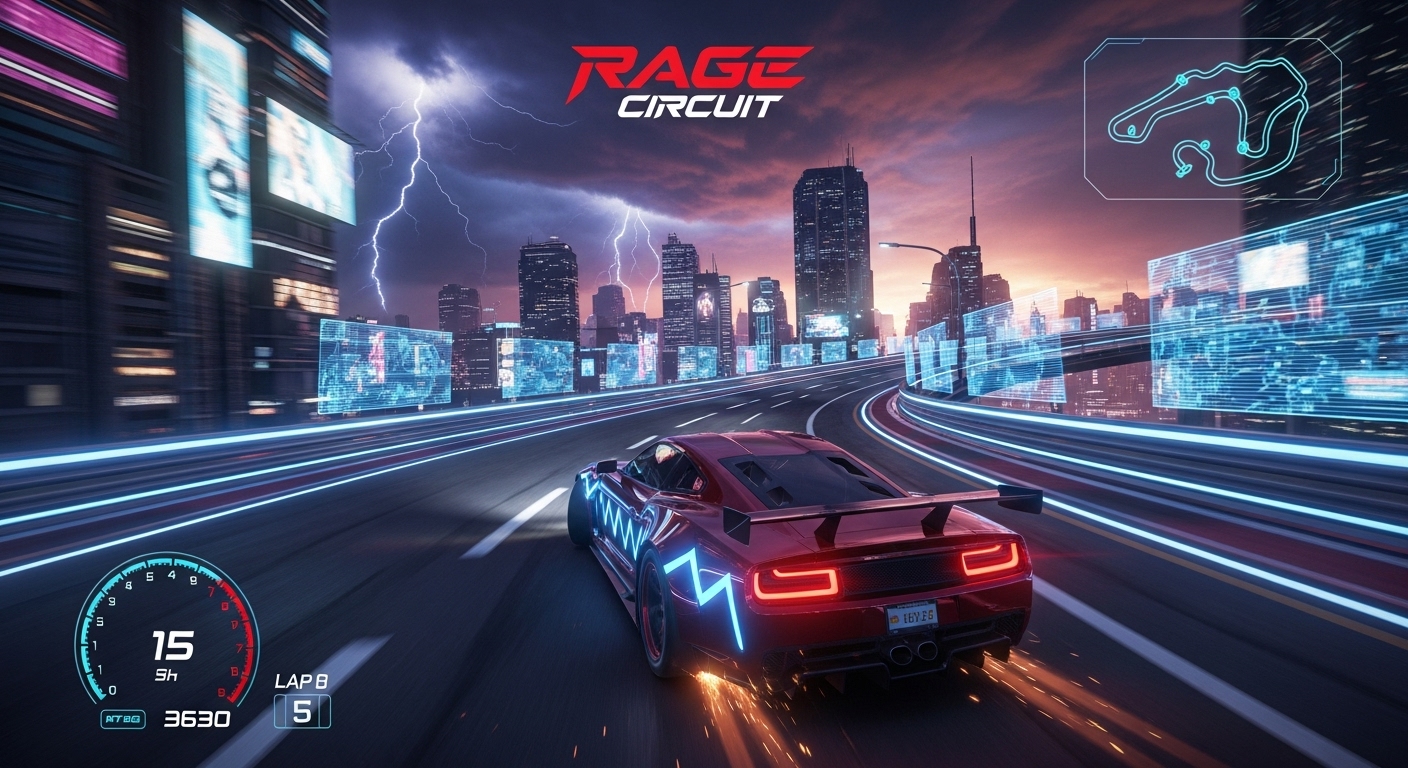
The premise is immediately gripping. You are a driver on a deadly, high-speed circuit where the only rule is that there are no rules. It is a vehicular combat arena, a ballet of nitrous boosts and brutal collisions set against a vibrant, neon-drenched cyberpunk backdrop. The immediate goal is simple: be the first to cross the finish line. The method to achieve that, however, is where the game reveals its depth. You can outmaneuver your opponents with slick driving, or you can engage the “rage” mechanic—a system that allows you to directly dismantle the competition with calculated, violent force.
More Than Mindless Mayhem: The Strategy of Rage
It would be easy to dismiss Rage Circuit as a simple cathartic release. The screen shakes, metal crunches, and the explosive sounds of success are visceral and loud. Yet, beneath this layer of sensory overload lies a carefully crafted strategic core. The “Rage” in the title is not a suggestion to play in a blind fury; it is a resource to be managed.
Your rage meter builds as you perform daring acts—drifting around tight corners, narrowly avoiding crashes, or landing successful hits. When the meter is full, you can activate a temporary state of immense power, allowing you to smash through opponents with ease. The crucial decision lies in when to activate it. Do you use it immediately to break through a pack of cars at the start? Or do you save it for the final lap, holding onto that potential energy as a trump card against the leader?
This element of choice transforms the experience. It shifts the player’s mindset from one of reactive aggression to one of mindful anticipation. You begin to read the race not just as a series of turns, but as a flowing narrative of risk and reward. You learn to breathe through the chaos, to watch for the right moment. In this space between the action, a peculiar kind of calm can emerge. It is the calm of focus, of being entirely present in the moment, where the roaring engines and blaring sirens fade into a backdrop for your own concentrated intent.
The Aesthetics of Controlled Chaos
The world of Rage Circuit is a character in itself. The developers have crafted a cyberpunk aesthetic that feels both alive and strangely meditative. Rain-slicked streets reflect the garish glow of holographic advertisements. The dense, towering architecture of the city whips by in a smear of light and color. There is a rhythm to the visual and auditory design that, once you acclimate to it, becomes almost hypnotic.
The synth-wave soundtrack, with its pulsing basslines and driving melodies, doesn’t just accompany the action—it guides it. Your vehicle becomes an instrument in this electronic symphony, with the screech of your tires and the blast of your weapons adding percussion to the score. By surrendering to this rhythm, the game becomes less of a stressful scramble and more of a coordinated dance. You are not fighting against the chaos; you are learning its steps and moving with it.
This is where the calm tonality of the experience truly takes root. It is not a peace found in silence, but a peace found in harmony with noise and motion. It is the same feeling one might get from being in the heart of a bustling city or watching waves crash relentlessly against the shore. There is a powerful, ordered pattern within the apparent disorder, and finding your place within it is profoundly satisfying.
The Track as a Teacher: Lessons from the Circuit
As with any challenging endeavor, Rage Circuit is a teacher. Its lessons are imparted not through text boxes or tutorials, but through the immediate, unfiltered feedback of the racetrack. The first and most important lesson is acceptance. You will crash. You will be taken out by a rival’s well-timed missile. You will misjudge a corner and slam into a wall, watching your lead evaporate in an instant.
Frustration is a natural initial response. But the game encourages you to move beyond it. There is no time for rage when you are already on the Rage Circuit. The only productive path is to accept the setback, reset your focus, and re-engage. This is a powerful metaphor for handling setbacks in our own lives. The mistake is not what defines the race; it is how you recover from it that matters.
Furthermore, the game teaches the value of flow state—that psychological concept of being fully immersed and energized in an activity. When you are in the zone in Rage Circuit, your actions feel instinctual. You are not consciously thinking “drift now, boost now, attack now.” You are simply doing. The separation between you, the controller, and the screen dissolves. This state of effortless concentration is a form of active meditation, a welcome respite from the fragmented attention demanded by our modern world.
Crossing the Finish Line, With a Calm Mind
Rage Circuit may wear the mask of a brutal, aggressive arcade racer, and on that level, it delivers excellently. It is a thrilling, heart-pounding experience that satisfies the primal urge for speed and competition. But to see it only for its surface-level intensity is to miss its deeper offering.
It is a game that uses chaos as a medium to teach focus. It uses aggression as a system to encourage strategic patience. And it uses a world of sensory overload to guide the player toward a state of rhythmic, mindful flow. In the silent moment after a race, when the engines have cooled and the neon lights have faded from your vision, you are often left not with the jitters of adrenaline, but with a quiet, steady sense of accomplishment. You navigated the storm. You found your line through the chaos. And in doing so, you may have found a small, unexpected pocket of stillness within yourself.
“`